
GRACE GLOBAL
Empowering Minds, Shaping Futures
Empowering Minds, Shaping Futures


Connect with us for best results with our quality driven tutoring tailored to your goals.
At GGES, We have the best expertise for SAT Test preparation. With past experience of 15 years, we know the best pedagogy for SAT Test prep. This gives our students the best SAT scores. For best SAT test prep we give our students the best SAT practice test and their solutions. As SAT prep test involves lots of strategies, so we ensure the best methods to teach these. Our best-made SAT subject test gives the best SAT practice to our students which ensures the best SAT scores
As our students believe SAT exam is best prepared by us. So do we believe our SAT practice test gives our students the best analysis of overall preparation. Be it SAT words, SAT vocabulary, or SAT essay, our SAT test preparation is the best when it comes to SAT tutoring. Our SAT test online tutoring is more effective when a student has a busy schedule and thus has less time for personal coaching efforts. So what are you waiting for? Looking for SAT preparation tutoring, you have reached the right place.
So why wait? To avail a Free Trial Class for SAT Test Prep Online Tutoring,
Click here for Free Trial Class
The SAT is composed of two sections: (1) the Reading and Writing section, and (2) the Math section. You have 64 minutes to complete the Reading and Writing section and 70 minutes to complete the Math section for a total of 2 hours and 14 minutes.
Each section is divided into 2 equal length modules, and there is a 10-minute break between the Reading and Writing section and the Math section. The first module of each section contains a broad mix of easy, medium, and hard questions. Based on how you perform on the first module, the second module of questions will either be more difficult or less difficult.
The following table shows how much time you get for each section and the number of questions for each section:
| Component | Time Allowed (minutes) | Number of Question / Tasks |
|---|---|---|
| Reading and Writing | 64 (two 32-minute modules) | 54 |
| Math | 70 (two 35-minute modules) | 44 |
| Total | 134 | 98 |
At GGES, we have specialized tutors for SSAT test prep. SSAT test online tutoring needs some best strategies and knowledge to get the best results. This is what our tutors have. The best of SSAT test prep is what our tutors give to you. SSAT exam preparation or as we call SSAT test tutoring with GGES secures the best scores for the student.
So why wait? To avail a Free Trial Class for SSAT Test Prep Online Tutoring.
Click here for Free Trial ClassBecause the SSAT helps test students for admission to private middle and high schools, different levels of the test are offered depending on where you are in your education. The Upper Level is designed for applicants in 8th grade and above. The Middle Level is for applicants in 5th, 6th and 7th grade, and the Elementary Level is for applicants in 3rd and 4th grade. No matter which level of the test you'll be taking, the SSAT will always test the same three sections—Quantitative (the Upper and Middle Levels have two sections of this, as opposed to one for Elementary), Reading Comprehension and Verbal Reasoning. The test also contains an unscored essay that is sent to the schools you're applying to. The Upper and Middle Levels of the SSAT contain one unscored experimental section of the test that contains Verbal, Reading and Quantitative questions. This section won't affect your score; it is used to make sure that future versions of the exam have reliable, acceptable questions.
The SSAT is given once a month from October to April, with an additional date in June. Flex dates, which are additional testing dates offered outside of the standard administrations, are also available. Check out available test dates and register today.
• 500-800 (Upper Level) • 440-704 (Middle Level) • 300-600 (Elementary Level)
• 500-800 (Upper Level) • 440-710 (Middle Level) • 300-600 (ElementaryLevel)
• 500-800 (Upper Level) • 410-710 (Middle Level) • 300-600 (Elementary Level)
It's not scored, but a copy is sent to the schools to which you apply.
All scores are converted to a grade-appropriate percentile.
Test names are the trademarks of their respective owners, who are not affiliated with The Princeton Review. The Princeton Review is not affiliated with Princeton University.
All questions on the SSAT are equal in value. Raw scores are based on the number of questions answered correctly minus one-quarter point for each question answered incorrectly. The SSAT score report will include multiple sets of scores and percentiles:
𝗦𝗦𝗔𝗧 𝗣𝗲𝗿𝗰𝗲𝗻𝘁𝗶𝗹𝗲 𝗥𝗮𝗻𝗸𝘀 𝗳𝗼𝗿 𝗲𝗮𝗰𝗵 𝗰𝗮𝘁𝗲𝗴𝗼𝗿𝘆 (𝟭-𝟵𝟵%) The SSAT percentile ranks compare your scores to similar students who have taken the SSAT in the past three years. Heads up, the essay section is not graded, but a copy of the essay will be sent to a school or consultant.
So why wait? To avail a Free Trial Class for SSAT Test Prep Online Tutoring,
At GGES, We have the best teachers with lots of experience in PSAT test tutoring with excellent results. Our Tutoring plan is with maximum flexibility to meet your needs and your schedule while preparing for PSAT test prep. Our tutors are caring, committed, captivating instructors who work with students with the latest and the best PSAT practice test. PSAT exam practice with PSAT test exams with score analysis help to identify areas for improvement and target your PSAT prep. PSAT NMSQT test requires strategies that we expertise and are imparted to our students in the most efficient way.
The PSAT/NMSQT takes 2 hours and 14 minutes and consists of 2 sections: (1) the Reading and Writing Section, and (2) the Math Section. Most of the questions are multiple choice, though some math questions ask you to write in the answer rather than select it. The following table shows how much time you get for each section and the number of questions for each test:
| Section | Length (minutes) | Number of Questions / Tasks |
|---|---|---|
| Reading and Writing | 64 | 54 |
| Math | 70 | 44 |
| Total | 134 | 98 |
| Grade Level | Season | Exam |
|---|---|---|
| 8 | Fall or Spiring | PSAT™ 8/9 |
| 9 | Fall or Spiring | PSAT™ 8/9 |
| 10 | Fall | PSAT/NMSQT |
| 10 | Spiring | PSAT™ 10 |
| 11 | Fall | PSAT/NMSQT |
| 11 | Spiring | SAT |
| 12 | Fall | SAT |
The Specialized High Schools Admissions Test (SHSAT) is an exam 8th and 9th graders take for admission to Specialized High School in New York City. For eight out of nine of these schools, your performance on the SHSAT is the only admission factor.
The test is administered at students’ home schools on specific school days or at testing sites on pre-determined weekends. Beginning with the fall 2025 SHSAT, the test will be administered digitally for all students except those who have 504 or IEP accommodations that require a paper and pencil version of the test. In the fall of 2026, the SHSAT will become a computer-adaptive test (CAT). This means the test will adjust the difficulty of questions based on the individual student's performance
The SHSAT test dates are usually offered in late October for school day testing, mid-November for 8th graders, and early December for 9th graders. The ninth grade SHSAT is for first-time test takers and for students who want a second chance to apply to a Specialized High School. We do not recommend waiting until 9th grade to take the test as these high schools have a very limited number of 10th grade seats available.
There are two SHSAT sections: English Language Arts (ELA) and Math, each with 57 items. Start to finish, the test will take you three hours (180 minutes).
Our expert tutors and strategic plan help you score higher and secure admission to top specialized high schools.
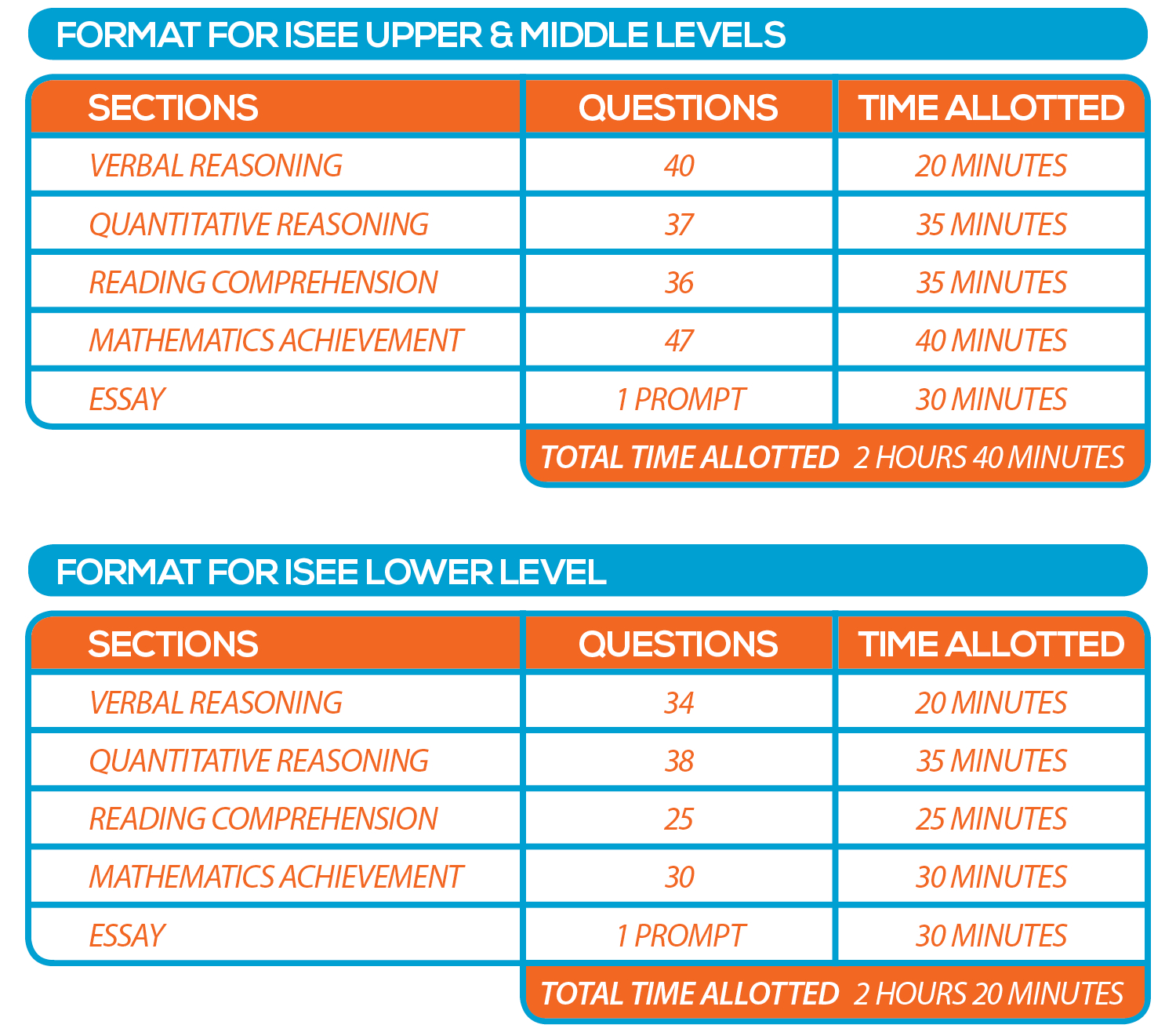
Book Free Trial ClassSo why wait? To avail a Free Trial Class for ISEE Test Prep Online Tutoring.
Primary, Lower, Middle, and Upper, based on the grade a student is applying for.
Verbal Reasoning, Quantitative Reasoning, Reading Comprehension, Mathematics Achievement, and an Essay.
The essay is unscored but is sent to the schools along with the student's score report.
The test can be taken online at home or in a traditional paper-based format.
Vocabulary and verbal skills.
Problem-solving skills and logic.
Understanding and analyzing passages.
Knowledge of mathematical concepts.
Written communication skills.
At GGES, ELA is tutored by expert teachers who have tons of experience in ELA Test prep tutoring. As a language it becomes important to provide a strong base to students through ELA, so we are determined to do so.
Students in grades 3–10 take the State English Language Arts (ELA) test each spring. These assessments measure the Common Core Learning Standards (CCLS).
An ELA (English Language Arts) test is a standardized assessment that measures a student's proficiency in reading, writing, listening, speaking, and language skills, often aligned with academic standards like the Common Core. These tests typically involve reading passages and answering multiple-choice, short-answer, or essay questions to evaluate comprehension, analytical thinking, and the ability to construct well-organized written responses. ELA tests help identify a student's strengths and weaknesses in literacy, providing crucial data for guiding instruction and evaluating college and career readiness).
Core components and formats
Tests feature a mix of selected-response (multiple-choice), short-answer, and long-form essay prompts that require students to analyze texts and use evidence.
Students read and analyze various genres, including fiction, nonfiction, and sometimes multimedia like videos, drawing evidence from the passages to support their answers.
The tests measure a wide range of skills, including reading comprehension, literary analysis, vocabulary, grammar, and the ability to write well-organized, evidence-based responses. Test administration
Tests are often divided into parts or units, and can be administered in a single session or over multiple days.
The format can be paper-based or computer-based, with some online tests using adaptive technology where the difficulty of the next question changes based on the previous answer.
Responses are combined to yield a comprehensive score. Some questions, especially those requiring written answers, are scored using specific rubrics. Preparation
To prepare, it is beneficial to spend time reading a wide variety of texts to improve comprehension and familiarity with different literary devices.
Practice writing well-structured essays that use evidence from passages to support arguments.
Strengthen knowledge of grammar rules and vocabulary to improve performance on language and convention sections.
SCAT test is an above-grade-level test, after the test, you’ll receive information that shows how your child’s score compares to that of students in his or her grade as well as students in the higher grades for whom the test questions were originally designed.
The SCAT test has two sections, verbal and quantitative. Each section contains 55 questions, including five unidentified experimental items that do not count toward the student’s score.
The verbal section measures a student’s understanding of the meaning of words and verbal reasoning ability. Verbal questions are multiple-choice analogies, which require a student to choose the best pair of words to complete an analogy. Often, there may appear to be more than one answer that fits the analogy, but the correct answer is the one that best completes the analogy.
The quantitative section measures a student’s understanding of fundamental number operations. The quantitative questions are multiple-choice mathematical comparisons, which require a student to compare two mathematical quantities and determine which is greater. Problems are intended to measure mathematical reasoning ability and thus often do not require computation.
SCAT Test Scaled Scores range from 401 to 514 depending on the level the student takes. Here are the ranges:
Verbal Range = 401-471 Quantitative Range = 412-475
Verbal Range = 405-482 Quantitative Range = 419-506
Verbal Range = 410-494 Quantitative Range = 424-514
This scaled score is based on the number of questions the student answers correctly out of the 50 scored questions in each section.
However, during our sessions on the SCAT test preparations, we equip our students by giving Tips and Tricks to answer SCAT test questions quickly and accurately. Still here are general tips for taking the SCAT test:
You can make an appointment with Prometric online at www.prometric.com/jhucty or by phone at 800-688-5796. The call center is open from 8 a.m. to 8 p.m. EST on weekdays. The SCAT test fee is $60 (US only), payable by credit card or electronic check. The fee will be charged immediately. Please call or go online at least three weeks before your preferred testing date. Students must test by June 30, however, if you are interested in Summer Programs, please test as early as possible. Registration for summer courses opens in January and spaces fill quickly.
You will be required to have your 9-digit SCAT Authorization Number from CTY before you call to schedule your SCAT testing appointment. If you received test registration information by mail, the testing authorization number is printed on the registration packet envelope. If you received test registration information by email, the authorization number is in the body of an email from CTY. If you’ve lost or cannot find the authorization number, you can access it by logging into MyCTY at www.ctyjhu.org/mycty/
At GGES, we have expert AMC tutors who are well qualified and experienced in AMC Test online tutoring.
The AMC contests are designed to engage students and teachers in effective mathematical problem solving that is consistent with curricular goals, and to prepare students for future mathematical success. The American Mathematics Competition sets the standard for preparing today’s students for succeeding in mathematics in postsecondary education and careers. We’re truly preparing today’s students to solve tomorrow’s challenges.
The MAA AMC proudly engages with a dedicated group of participants, each crucial to the success of our mathematical community:
The AMC 8 is a great way to introduce younger students to mathematical problem-solving beyond the standard school curriculum. Students who enjoy the AMC 8 may want to continue with the AMC 10 and AMC 12 in later years.
For: Middle school students in grades 8 and below, with a maximum age of under 15.5 years on the day of the competition.
When: Annually in January over the course of a week. Students may only take the AMC 8 once each year.
The AMC 10 provides students with an opportunity to develop their problem-solving skills. It serves as the first step in qualifying for the USA team in prestigious international mathematics competitions, including the International Mathematical Olympiad.
The AMC 10 is a 25-question, 75-minute multiple-choice competition
designed for students in grades 10 and below. The content covers mathematical topics
such as elementary algebra, basic geometry, area and volume formulas, elementary
number theory, and elementary probability. Advanced topics like trigonometry,
advanced algebra, and advanced geometry are excluded.
The AMC 10 offers two versions of the test, the 'A' and 'B' competitions. Competition
managers can choose the date that best fits their schedule or have their students
participate in both.
For: High school students in grades 10 and below, with a maximum age of under 17.5 years on the day of the competition.
When: Annually in November on the same dates as AMC 12. Students may not take both AMC 10 and AMC 12 on the same day.
The AMC 12 helps students develop their problem-solving abilities and serves as the first step in qualifying for the USA team in prestigious international mathematics competitions, including the International Mathematical Olympiad.
The AMC 12 is a 25-question, 75-minute multiple-choice competition
designed for students in grades 12 and below. It covers the full high school
mathematics curriculum, including trigonometry, advanced algebra, and advanced
geometry. Calculus is excluded.
The AMC 12 offers two versions of the test, the 'A' and 'B' competitions. Competition
managers can choose the date that best fits their schedule or have their students
participate in both
For: High school students in grades 12 and below, with a maximum age of under 19.5 years on the day of the competition.
When: Annually in November on the same dates as AMC 10. Students may not take both AMC 10 and AMC 12 on the same day.
Mathematical Kangaroo is an international mathematical competition with more than 50 countries that take an active part in it. There are twelve levels of participation: from grade 1 to grade 12. We take pride in apprising that GGES has got the best online Math Kangaroo tutoring. We have specialized tutors who understand the core and skill level of Math Kangaroo and thus assist students by giving the best approach towards Math Kangaroo test prep.
We have the best content and specialized tutors available for Maths Kangaroo.
At GGES, We have the best tutors to impart the best tutoring for SAT and ACT test prep. ACT test prep tutoring requires expert skill to negotiate the changes and the challenges of the ACT test. Our tutors are well-skilled and expert to impart the latest and most suited online tutoring for ACT Test Prep.
English, math, raeading, and science.
Writing and science tests are often optional, though the English, math, and reading sections are mandatory for a composite score.
The test covers knowledge and skills taught in high school courses up to the beginning of grade 12.
The English section measures revision and editing skills, math measures mathematical skills, reading measures close reading and logical reasoning, and science measures scientific reasoning and problem-solving skills. Scoring and score reporting
The ACT is scored on a scale of 1–36, based on the average of the English, math, reading, and science section scores.
The test also provides subscores that highlight individual strengths and areas for improvement.
Students can have their scores sent to colleges and scholarship agencies after they take the test.
The fee varies depending on the version of the test taken and any additional options selected. Fee waivers are available for eligible students.
Most students take the test in the spring of their junior year of high school and may choose to take it a second time.
Colleges use the ACT to compare applicants from different educational backgrounds and assess their academic readiness for college.
Some colleges also accept the SAT, another standardized college admissions test.
The "ACT" can also refer to the "Activated Clotting Time" test in medicine, which measures blood clotting time and is entirely different from the college admissions exam.
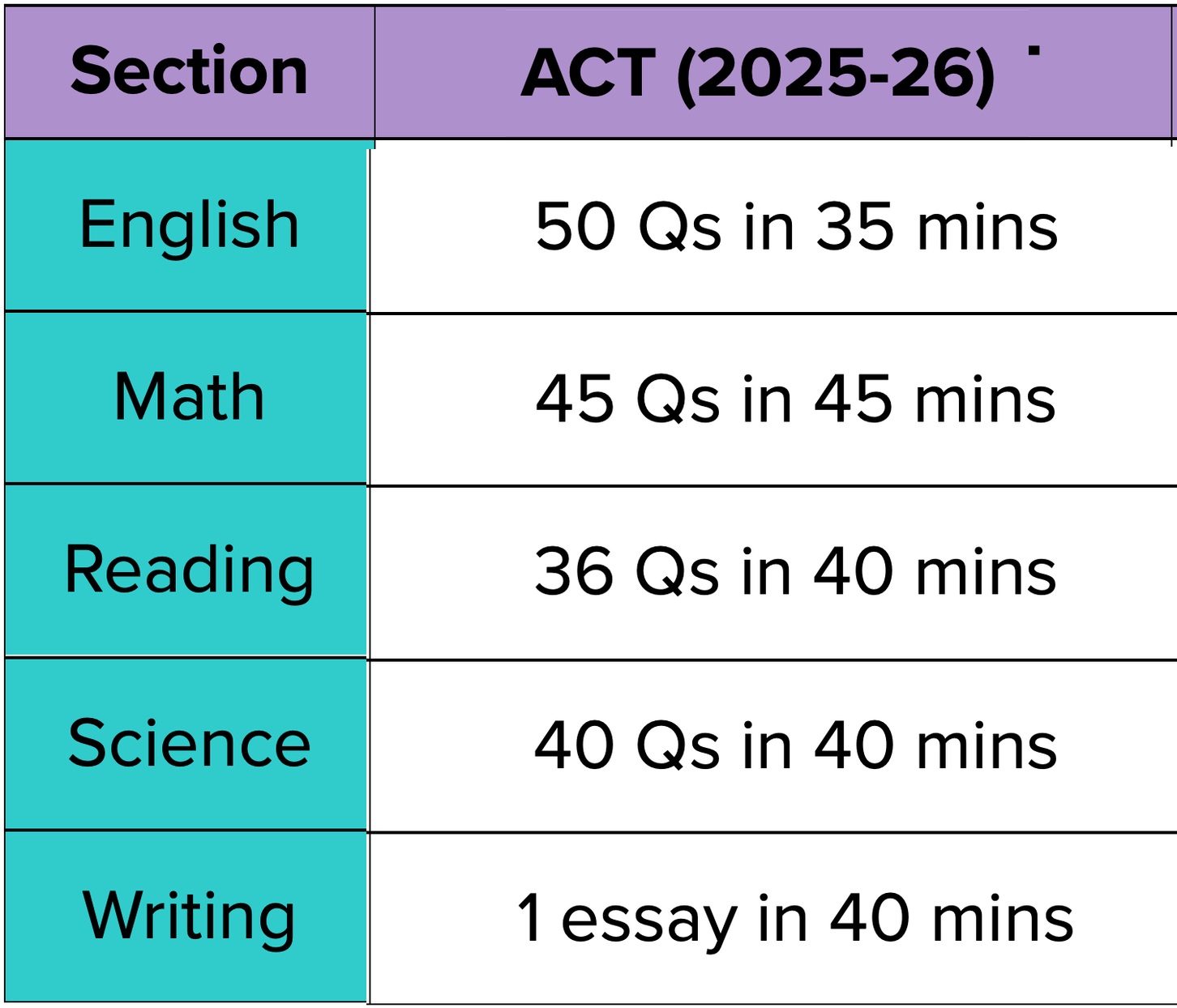
If you were going to take the ACT right now—before the makeover—you would take the test in four multiple-choice sections: English, Math, Reading, and Science. You'd be required to complete all four of these sections because your composite score would average your score of all four parts. And if you wanted to complete the essay (also known as the Writing section), that would be optional.
Well, big change #1 is that soon the Science section will no longer be required, either.
So beginning as early as April of 2025, the new format of the ACT will only require a core of three sections: English, Math, and Reading. So you would be required to do those three, but you will only take Writing and/or Science if you want to complete one or both of them and have specifically signed up for them.
Your composite score (out of 36) will no longer take into account how you did on Science questions. The only three sections that count towards your composite score will be English, Math, and Reading. If you opt to take the soon-to-be-optional Science or Writing sections, you will receive separate score reports for those sections.
44 fewer questions total, to be specific. In terms of the core three sections that are going to matter in the new iteration of the test—English, Math, and Reading—the questions like in three sections will give you:
• 50 questions for English
• 45 for Math
• 36 for Reading
• 131 questions total
So unless you’re taking the optional Science section, the new test will be slimming down from 175 to 131 multiple-choice questions—a difference of 44 Qs!
The fourth big change with the new format of the ACT is that your total testing time is going to be reduced. And that’s not just true for those people who decide to opt out of the Science section, thus cutting down the total number of sections you sit for.
That’s right: the period of time it takes to complete each of the remaining required sections—English, Math, and Reading—will also be shorter:
• If you take three sections only, you’ll be taking a two-hour test—literally 120 minutes on the dot—if you're a regular-time test taker.
• If you add on the optional Science section, your test will be two hours 40 minutes.
• If you add Writing (but not Science), it would also be two hours 40 minutes.
• And if you decide to sign up for BOTH of the optional sections—the main test plus Science plus the essay—then that would be 3 hours 20 minutes for a regular time test taker.
The fifth change of the new format of the ACT is that the test will no longer be as fast-paced. As in, you’ll get more time to answer each question.
That’s because the ACT did not reduce the # of questions and the time allotment perfectly in proportion. Between reducing the total time you’re in your seat and reducing the number of questions you have to answer, here’s how it breaks down:
• Current ACT (with four required sections): 215 questions in 175 minutes
• Roughly 48.8 seconds per question.
• New ACT, if you only do the three required sections: 131 questions in 120 minutes,
• Roughly 55 seconds per question.
So in 2025-26 you’ll be shifting your pace from a little under 49 seconds per question to 55 seconds per question—a difference of a little over six seconds per question!
In addition to the sections themselves being shorter time-wise and containing fewer questions, those two changes will, in turn, affect some sections more than others. The sections that will be affected most dramatically by the slower timing of the new ACT are those that include passages—the English and Reading sections. Specifically, the actual passages themselves will be shorter in both sections.
We don't know yet exactly how the new version of the test will distribute passages and questions across these two sections. As a reminder, here’s how it works on today’s test:
• The English section currently comprises five passages each with 15 questions apiece.
• The Reading section currently comprises four passages each with 10 questions apiece.
When you currently take the ACT, about half the time, you end up being given a fifth section (the "experimental section").
Well, that’s because the ACT wants to test out potential future test questions to assess their difficulty level—before the exam actually incorporates those questions and start counting them towards real scores.
The ACT finally came to terms with test-takers’ tendency to slack on the experimental section, and realized they’re not going to get accurate data on those questions if they’re all lumped into one section that everyone knows doesn’t count towards their actual score.
So instead, what the new ACT will do is plant experimental questions inside the actual sections of the test. In other words, the English section—which, if you’ll recall from above, will soon only have 50 questions—will have some real questions and some “tester” questions among those 50. We don't know exactly how many will be counted towards your 36 points and how many will be experimental, but we know that SOME of them will go uncounted. That means you now have to answer ALL of the questions you come across as if your life depended on it because you don't know which ones are going to count towards your composite score and which ones aren't.
To know more or to take a Free Trial Online tutoring class for ACT or SAT test preparation tutoring,
Click here for Free Trial ClassAt GGES, COGAT Test prep is something, we proudly claim to be the best tutor of. Our expert teachers have been co-authors of some famous COGAT publications too. As COGAT requires a different approach, we make sure that our tutoring methods suit every student. GGES makes the best tutoring options for a number of reasons:
Hundreds of CogAT practice questions similar to the test to help your child recognize each of the nine CogAT question types and apply the right strategies to answer them correctly.
A customizable program, based on your child’s grade level and upcoming tests, so you can target your child’s prep for maximum improvement.
Interactive practice with 30+ games from top educational publishers to strengthen your child’s overall skills like math, language arts and more.
A Parent Success Team to help you if you need a little advice or if you get stuck.
Over 100,000 practice questions for the most popular tests for Pre-K to 8th Grade, including gifted and talented, private school admissions, state tests and more—all for one low price.
Parent resources to help you easily navigate your child’s testing process.
The CogAT consists of a verbal battery, quantitative battery, and nonverbal battery. Each battery is a separate section of the test containing 3 different types of questions that cover unique cognitive abilities.
| Verbal Battery | Quantitative Battery | Non-Verbal Battery |
|---|---|---|
| Picture Analogies | Number Analogies | Figure Matrices |
| Sentence Completion | Number Puzzles | Paper Folding |
| Picture Classification | Number Series | Figure Classification |
Unlike achievement tests such as the SATs, the CogATs do not measure how much a student has learned, but focuses instead on a student’s ability to display cognitive abilities that researchers has associated with academic success. These abilities include reasoning and problem solving using verbal, quantitative, and spatial (non-verbal) methods to find the answers.
There are 14 different levels of the CogAT that vary in difficulty, number of questions, question types, and length. Your child’s age determines which CogAT level they are tested with. Many characteristics of the test are consistent across all levels:
You will need to contact your child’s school to figure out the testing methods they
will be using. The 3 most important questions to ask are:
As mentioned above, it’s important to ask your child’s school which CogAT level they will be administering. Schools can choose to administer an above-grade-level test if they are looking for highly gifted students. They may also choose to give a below grade level test if students are being tested at the beginning of the year. The grades and CogAT levels listed below are the most common.
| Grade | Level | Questions | Time |
|---|---|---|---|
| Kindergarten | Level 5/6 | 118 | 112 min |
| 1st Grade | Level 7 | 136 | 112 min |
| 2nd Grade | Level 8 | 154 | 122 Minutes |
| 3rd Grade | Level 9 | 170 | 90 Minutes |
| 4th Grade | Level 10 | 176 | 90 Minutes |
| 5th Grade | Level 11 | 176 | 90 Minutes |
| 6th Grade | Level 12 | 176 | 90 Minutes |
| 7th – 8th Grade | Level 13/14 | 176 | 90 Minutes |
| 9th – 10th Grade | Level 15/16 | 176 | 90 Minutes |
| 11th – 12th Grade | Level 17/18 | 176 | 90 Minutes |
Administration time may vary, depending on how long the proctor takes to administer the test. Students are generally given between 20-45 minutes per battery. Let’s analyze the sections below.
These visual based questions make use of 2×2 matrix with 3 pictures and 1 empty cell. Students are required to examine the 2 pictures on top so to their point of relation. The most optimal approach to this question is to start by looking at the picture on the bottom row. The objective is to ensure that the three pictures on the bottom have a parallel relationship to the pictures on top. This section is comprised of 14 questions and takes approximately 15 minutes to complete.
Students are required to listen to a sentence or question and select the picture that best satisfies the sentence or answers the question. This section is made up of 14 questions and takes approximately 14 minutes.
Students examine 3 pictures on top and determine how they are alike. Then, they must choose the 1 picture on the bottom that belongs in the same group. This section is composed of 14 questions and takes approximately 14 minutes to complete.
These figure analogies require the same thought processes as Picture and Number Analogies. Still, instead of verbal or quantitative concepts, students must identify relationships between spatial forms. By studying and identifying distinct points of relation between previous figures, students can asses possible answer choices. This section consists of 14 questions and takes approximately 11 minutes to complete.
Students must imagine what will happen to a piece of paper that is folded, then cut or hole-punched in some way, and then unfolded. The TestingMom.com website has a fun, animated game to help students with this subtest. This section consists of 10 questions and takes approximately 10 minutes to complete.
These require the same thought process as Picture Classification, except instead of inferring relationships between pictures, students infer relationships between shapes and figures. They then must find the answer on the bottom that belongs with the group on top. This section includes 14 questions and takes approximately 10 minutes to complete.
These require the same thought processes as Picture Analogies except instead of verbal concepts, students must identify relationships between quantitative concepts. Like the verbal battery, this section consists of 14 questions and takes 13 minutes
Students see 2 trains. They must select the answer picture that makes the second train carry the same number of objects as the first train. This section includes 10 questions and takes 11 minutes.
Each question shows an abacus with a bead pattern. Students must rely on their patterning skills and select the string of beads that comes next in the sequence. 14 questions. Approximately 10 minutes.
So why wait? To avail a Free Trial Class for Accuplacer Test Prep Online Tutoring,
Get Free Trial ClassWe have expert tutors who are best in SBAC Online tutoring. For SBAC tests we understand the intellect and need of the student and thus develop our pedagogy to suit the requirement of the student. Periodic assessments and tests are conducted to keep a track of student’s progress in SBAC and the best of the materials and support is provided.
The Smarter Balanced Assessment Consortium (SBAC) is a standardized test consortium. It creates Common Core State Standards-aligned tests (“adaptive online exams”) to be used in several states. It uses automated essay scoring. Its counterpart in the effort to become a leading multi-state test provider is the Partnership for the Assessment of Readiness for College and Careers (PARCC).
In 2010, the consortium was created. The Amplify technology company provides digital technology for the tests. SBAC signed a contract with Amplify to create a digital library of formative assessment professional learning tools designed for Common Core State Standards teachers. Amplify also signed a contract with Smarter Balanced before its purchase by News Corp to develop reporting tools for teacher assessment.
Beginning in the Spring of 2015, SBAC began assessing students with their new assessment format. The assessments are given in grades 3 – 8 and 11, in the content areas of Math and English Language Arts. Each test called a Summative Assessment, consists of a Performance Task (PT) and a Computer-Adaptive Test (CAT).
All students in grades 3 through 8 take the Smarter Balanced Summative Assessment.
Students are assessed in the areas of English Language Arts (ELA) and Mathematics.
SBAC assessments are given during the spring each year.
The SBAC Summative Assessments consist of two parts: a computer adaptive test (CAT) and a performance task. The CAT adjusts the difficulty of questions throughout the assessment based on the student’s response in order to identify a student’s threshold of knowledge. If a student answers a question correctly, the next question will be more challenging; if a student answers incorrectly, the next question will be less challenging.
Each SBAC Assessment has an approximate testing time of four hours. If students complete both the English Language Arts/Literacy and the Mathematics Exam in the same testing period the combined testing time would be approximately 7 hours.
The Spatial Test Battery (STB) is a thorough assessment of visual-spatial ability that is used in conjunction with other tests to determine admissions to the Johns Hopkins University Center for Talented Youth (CTY). Spatial visualization is a comprehensive ability that can be measured by students abilities in facial recognition, shape rotation, mental imagery, and other spatial relationships; children who are visual-spatial learners often find it easier to learn through graphs, charts, or other graphics than through text or listening. The four subtests of the STB are designed for children who demonstrate an interest in and or talent for, computers, graphic design, and science. The STB is administered on computers at numerous locations around the United States.
The exam is designed so that students complete the easier before moving onto the increasingly more difficult tasks. The test format is multiple choice, as there is only one correct response to each question. If the student is unaware of the correct answer he or she has the option of skipping the question. Later on, but while within the same subtest, he can return to complete the question. Once the student exits a subtest, he can no longer complete nor change their answer to any questions within that subtest.
The following is a description of the four subtests that the student will complete on the STB test:
| Subtest + Tutorial | 5th/6th Graders: Time Allowed | 7th Graders+: Time Allowed |
|---|---|---|
| General Tutorial | 15 min | 15 min |
| Questionnaire | 4 min | 4 min |
| Visual Memory: Memorization Phase Instructions | 3 min | 3 min |
| Visual Memory: Memorization Phase Viewing of Shapes | 8 min | 8 min |
| Surface Development: Tutorial | 4 min | 4 min |
| Surface Development: Exam | 12 min | 12 min |
| Block Rotation: Tutorial | 5 min | 5 min |
| Block Rotation: Exam | 12 min | 12 min |
| Visual Memory Recall Phase: Repeated Instructions | 2 min | 2 min |
| Visual Memory Recall Phase: Exam | 8 min | 8 min |
| Perspectives: Tutorial | Not given to 5th and 6th graders | 6 min |
| Perspectives: Exam | Not given to 5th and 6th graders | 19 min |
| Survey/Comments | 10 min | 10 min |
| Totals | 83 min | 109 min |